
Thermal Imaging for BESS Safety: Early Fire Detection and Thermal Runaway Prevention in Lithium Battery Storage
Lithium battery storage systems, including Battery Energy Storage Systems (BESS) and battery warehouses, are critical to modern energy infrastructure. Yet, they carry inherent risks of fire and thermal runaway that can cause catastrophic damage. Traditional fire detection methods often respond too late, after smoke or flames appear. This delay can lead to uncontrolled fires and severe safety hazards.
As lithium-based Battery Energy Storage Systems (BESS) continue to expand globally, advanced safety monitoring has become essential. Thermal imaging is now one of the most effective technologies for preventing catastrophic failures by providing actionable early warnings before smoke or flames appear.
Thermal imaging technology offers a powerful solution by detecting abnormal temperature rises early, before visible signs of fire emerge. This blog explains how thermal imaging enhances battery storage safety, prevents fires, and detects thermal runaway events in real time.
This makes thermal imaging for BESS safety one of the most effective methods for early fire detection, preventing thermal runaway events before they escalate.
Fire and Thermal Runaway Risks in Lithium Battery Storage
Lithium-ion batteries store high energy density, making them efficient but also prone to safety risks. The main hazards in BESS and battery warehouses include:
Thermal runaway: A chain reaction where battery temperature rapidly increases, causing internal short circuits, gas release, and potential fire or explosion.
Fire ignition: Faulty cells, mechanical damage, or electrical faults can ignite fires that spread quickly in dense battery arrays.
Delayed detection: Conventional fire alarms rely on smoke or flame detection, which activates only after the fire has started.
When a thermal runaway event begins, temperatures can rise sharply within seconds. By the time smoke detectors trigger, the fire may already be uncontrollable. This delay increases risks to personnel, equipment, and the facility.
Early detection of abnormal temperature changes is essential to prevent escalation. Monitoring temperature trends before visible signs appear allows operators to intervene promptly.
How Thermal Imaging Improves BESS Safety and Early Fire Detection
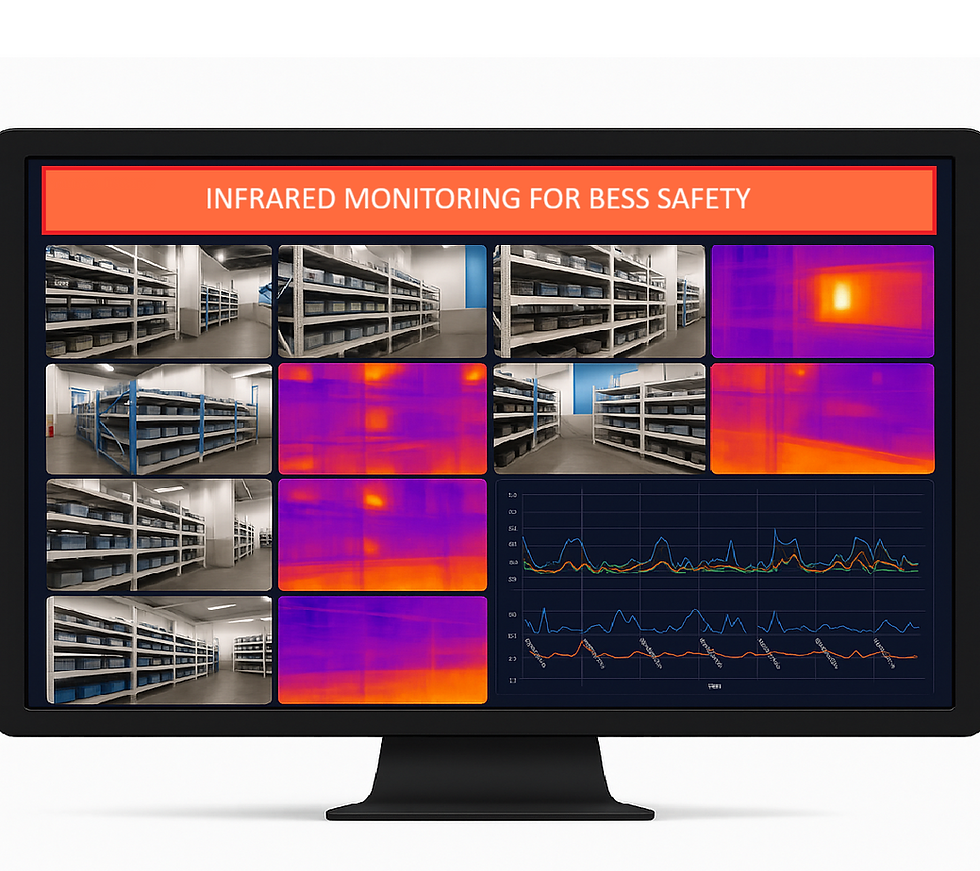
Thermal imaging cameras detect infrared radiation emitted by objects, translating it into temperature maps. In battery storage, thermal cameras continuously scan shelves, racks, battery modules, and individual packs to identify hotspots.
Key features of thermal imaging for battery safety include:
Real-time temperature monitoring: Cameras capture temperature data continuously, providing instant alerts when thresholds are exceeded.
Spatial temperature mapping: Thermal images show exact locations of heat anomalies, enabling precise identification of problem cells or modules.
Trend analysis: Monitoring temperature changes over time helps detect gradual heating before it becomes critical.
By detecting abnormal temperature rises early, thermal imaging enables operators to isolate affected batteries, activate cooling systems, or initiate emergency protocols before fire or thermal runaway occurs.
Benefits and Technical Functions of Thermal Imaging Systems
Thermal imaging systems for lithium battery storage offer multiple advantages that improve safety and operational efficiency:
Continuous Monitoring of Critical Components
Shelves, racks, battery modules, and individual packs are monitored 24/7.
Early detection of temperature deviations prevents unnoticed faults.
Reduces reliance on manual inspections, which can miss subtle changes.
Real-Time Detection of Abnormal Temperature Patterns
Systems use predefined temperature thresholds to trigger alerts.
Algorithms analyze temperature trends and spatial distribution to differentiate normal variations from dangerous heating.
Enables fast response to emerging issues.
Localization of Heat Sources Using AI and Visible-Light Cameras
Thermal imaging combined with visible-light cameras provides visual confirmation.
AI and deep learning algorithms analyze thermal patterns to identify specific cells or modules at risk.
Reduces false alarms and improves accuracy of fault detection.
Integration with Safety and Emergency Systems
Thermal imaging alerts connect to audible and visual alarms to warn personnel.
Automated firefighting equipment, such as sprinklers or gas suppression, can be triggered automatically.
Supports on-site emergency response plans with precise location data.
Remote Visualization and Predictive Maintenance
Dashboards display live thermal images and temperature data for remote monitoring.
Historical data recording enables trend analysis to predict potential failures.
Supports maintenance scheduling before faults develop into emergencies.
Engineering Considerations for Implementing Thermal Imaging in BESS
Designing and deploying thermal imaging systems in lithium battery storage requires careful engineering to ensure reliability and effectiveness:
Camera placement: Cameras must cover all critical areas without blind spots. Positioning depends on rack layout, battery size, and facility design.
Resolution and sensitivity: High-resolution thermal sensors detect small temperature differences. Sensitivity must balance early detection with minimizing false alarms.
Environmental factors: Dust, humidity, and ambient temperature affect thermal readings. Systems should include calibration and compensation features.
Data integration: Thermal imaging data should integrate with building management and fire safety systems for coordinated response.
Power and network reliability: Continuous operation requires stable power supply and secure data transmission.
Compliance and standards: Systems must meet industry safety standards and regulations for battery storage facilities.
Practical Example: Thermal Imaging Preventing a Thermal Runaway Event
In a large BESS facility, thermal imaging cameras detected a gradual temperature rise in a battery module over several hours. The system alerted operators before any smoke or flame appeared. Maintenance teams isolated the module and replaced faulty cells, preventing a potential fire. This early intervention avoided costly damage and downtime.
Contact Interberg for BESS Safety and Thermal Imaging Solutions
Interberg works with leading technology partners to design and supply complete thermal imaging safety solutions for lithium battery storage and BESS facilities. We help you select the right hardware, define the monitoring strategy and integrate the system into your existing energy storage infrastructure.
If you want to integrate thermal imaging, improve fire prevention or enhance BESS system monitoring, contact us to discuss your project and request a tailored proposal.
👉 Reach out to Interberg for a customized BESS safety solution. Email: contact@interberg.com


Comments