
Sodium-Ion Batteries
Safe, Sustainable and Cost-Efficient Energy Storage Solutions
Overview
Interberg Sodium-Ion Batteries represent the next generation of energy storage for stationary and industrial applications. Based on the movement of sodium ions between electrodes, their operating principle is similar to lithium-ion technology, while relying on abundant, non-critical raw materials and offering enhanced safety and thermal stability.
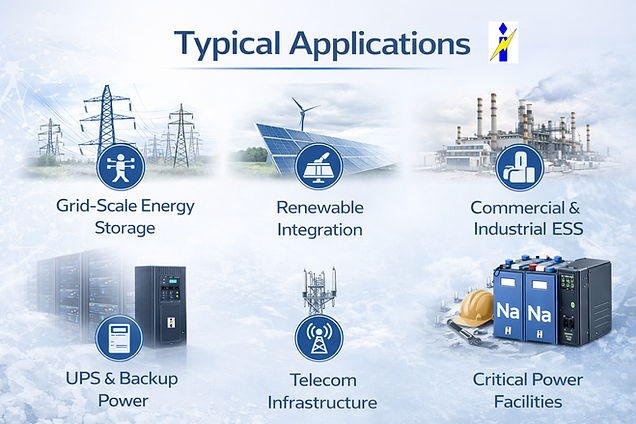
Designed for energy storage systems (ESS), UPS, grid support and industrial power applications, sodium-ion technology complements existing battery chemistries by providing a robust, cost-competitive and future-proof alternative where energy density is not the primary constraint.
Download our PDF due to Sodium-Ion Introduction 👉
Download our PDF due to Sodium-Ion Leaflet 👉
Why Sodium-Ion Technology
Key benefits include:
Abundant and low-cost raw materials
Sodium is widely available worldwide, reducing dependency on critical or geopolitically sensitive resources.
Enhanced safety profile
High overcharge tolerance, improved thermal stability and reduced risk of thermal runaway.
Excellent low-temperature performance
Reliable operation in cold environments where lithium-based batteries may suffer capacity loss.
High charge and discharge capability
Suitable for applications requiring high C-rate performance.
Lower long-term cost potential
As production volumes increase, sodium-ion battery costs are expected to decrease significantly, potentially becoming lower than LFP in large-scale deployments.
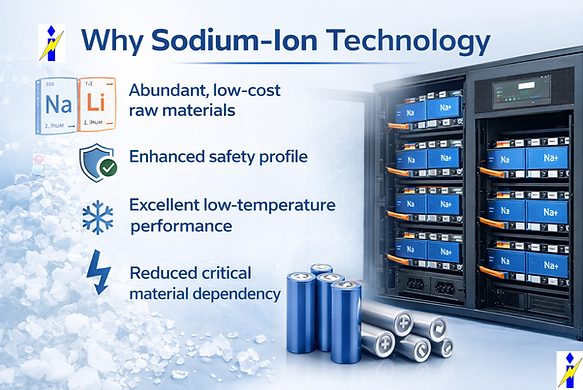
Sodium and lithium are adjacent elements in the periodic table and share similar electrochemical behavior. However, sodium offers several structural advantages that make it particularly attractive for large-scale and stationary energy storage.
Sodium-Ion vs. Lithium-Ion: A Complementary Approach
Sodium-ion batteries are not intended to replace lithium-ion in all applications, but to complement it.
Aspect
Sodium-Ion Batteries
Energy Density
Moderate
Safety
Very high
Low-Temperature Performance
Excellent
Raw Material Availability
Very high
Cost Stability
Best Use Case
High
Stationary ESS, UPS, grid support
Lithium-Ion Batteries
High
High
Limited
Limited
Subject to volatility
EVs, portable devices
Conclusion:
Sodium-ion technology is ideal where safety, cost stability and sustainability are more critical than maximum energy density.
Technical Highlights
-
Cathode: Copper-Iron-Manganese layered oxide
-
No precious metals
-
High structural stability
-
-
Anode: Anthracite-based amorphous carbon
-
Graphite-free
-
Stable supply and low cost
-
-
Current collectors:
-
Aluminum foil for both electrodes, reducing material cost
-
-
Over-discharge tolerance:
-
No permanent damage after deep discharge
-
-
Operating temperature range:
-
Superior performance at low temperatures
-

Product Formats & Configurations
Interberg Sodium-Ion Batteries are available in multiple industrial formats to support a wide range of applications:
-
Prismatic cells – large-scale ESS and grid applications
-
Cylindrical cells – compact systems and modular assemblies
-
Blade and custom formats – residential, commercial and industrial systems
All products can be integrated into rack-based systems, containerized ESS and UPS architectures.

Sustainability & Future Readiness
Sodium-ion batteries support the transition toward a more resilient and sustainable energy ecosystem:
-
Reduced environmental impact from raw material extraction
-
Lower dependency on critical minerals
-
Long-term supply security
-
Alignment with circular economy principles
As industrialization advances, sodium-ion technology is positioned to play a key role in the future of stationary energy storage.

Interberg Commitment
Interberg develops and supplies sodium-ion battery solutions under the same quality, safety and engineering standards applied across all our energy storage technologies.
Our team supports customers from technology selection and system design to integration and long-term operation, ensuring the right battery chemistry for each application.
Contact & Technical Support
Looking for sodium-ion batteries for your next project?
📩 Contact our technical team: contact@interberg.com
We will help you evaluate whether sodium-ion technology is the right solution for your application.
